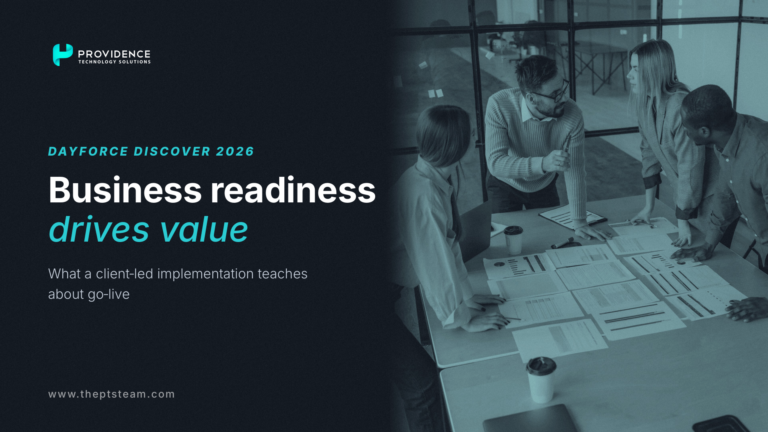
At Dayforce Discover 2026, Don Coleman of Providence Technology Solutions and Samantha Quattrone, Director of People Operations at Veritext, led a session called Beyond Dayforce Implementation: Building Business Readiness with Client-Side Support. The session asked one question about every implementation plan. Is the organization ready to operate and own the result? Dayforce business readiness rests on three things: clear decisions, testing that reflects how you work, and people who can run the system after go-live.
This article walks through what the session covered, stage by stage, so your team can apply it to its own project.
A readiness framework for every stage
The session framed client-side readiness in four stages:
- Prepare: outcomes, owners, capacity and data
- Implement: governance, coordination and decisions
- Validate: proof that the system, data, people and support model work together
- Sustain: stabilizing the live system, building adoption and improving over time
Each stage connects a project activity to a business responsibility. The framework applies at any stage, from setting capacity and decision rights during planning to clarifying ownership once the system is live.
Protect internal capacity from the start
Veritext moved to Dayforce from a long-time provider. Its HR team runs lean, and acquisitions kept shifting priorities while the project ran. The team needed time and someone to keep decisions moving when people were pulled back into daily work. Client-side support filled that gap with Dayforce expertise, structure and follow-through.
The lesson for any organization is to find resource gaps early. An implementation is intense work for the people inside it, and a gap found late puts go-live at risk.
Give every decision a clear owner
Governance mattered early in the Veritext project. Each decision needs an owner, the people whose input it requires and a named final authority. Veritext found that a smaller decision group reduced meeting fatigue and kept the project moving.
The configuration work is also a chance to design your future state. Ask whether each old process is the best way to work going forward. A process carried over without that question becomes a habit the new system has to support.
Test the way your organization works
Testing is where the project plan meets daily work. Written processes run into everyday pay rules, policies and edge cases. Testing also shows how connected Dayforce is, since one change can affect other areas.
For Veritext, the exceptions included rules that differ by state, employees in Canada and groups that joined through acquisitions.
Build test scenarios from the way your teams work, exceptions included. Findings can call for a configuration change, a process change, a new decision or more training. Use what testing turns up to guide each of those calls while there is still time to act.
Define what ready means for day one
A go-live decision needs a clear standard. The session described four signals of readiness:
- Critical functions work: system access, time entry, pay, benefits enrollment and time off requests
- Known risks are understood, and each open item has a workaround, a plan and an owner
- Employees, managers and support teams know what changes and where to go for help
- Essential operations come first, and polish follows once the system is live
Veritext worked to an aggressive timeline and weighed moving go-live to the next quarter. The team used this standard to make the call.
Plan for ownership after go-live
Go-live brings a new set of tests. Every decision made during the project now meets daily use, and employees notice each change. The client team takes on configuration, issue resolution and enhancements as the implementation structure steps back. Prosci makes a similar point in its guidance on adoption after go-live, where it describes the period after launch as the time that decides long-term value.
Stabilization gives the team room to learn how Dayforce runs in its own environment, and it builds a base for improving the system and getting more value from the investment.
What the client would do earlier
When asked what she would do earlier, Samantha pointed to four things:
- Protect internal capacity from the start
- Add support where it creates capacity
- Begin business readiness work sooner
- Challenge legacy processes and design for how you want to operate after go-live
Five takeaways for your Dayforce business readiness plan
- Define client-side success early, including readiness, ownership, adoption and value.
- Invest in client-side governance so decisions and issue resolution keep moving.
- Treat testing as readiness for the client team, the data, the process and the support model.
- Prepare your people, with adoption and communication built into the plan from the beginning.
- Plan for stabilization, with support, reporting and process refinement after launch.
Whether your project is in planning, underway or already live, these steps apply. Our team has helped organizations through every stage of a Dayforce project, from carrier file mapping at renewal to optimization after launch. To talk through where your Dayforce business readiness stands, visit theptsteam.com. For more on the event itself, see Dayforce’s Discover 2026 announcement.